
Every utility company knows today: the digitization of metering is essential. It enables the fight against 25% water losses (NRW) and ensures compliance with new European cyber security requirements (NIS2).
However, in this rapid transition to smart grids, one key question often arises: Who owns your data and infrastructure in the long term?
The story often begins with a great "turnkey" offer. Sounds ideal, right? One supplier, one contract, everything works right away. But this initial convenience comes at a hidden price, which is not reflected in the purchase price, but in the licensing and migration phases.
So how can you get the most out of digitization? How can you quickly detect leaks, control costs (TCO), and at the same time remain free, independent, and 100% compliant with all Data Act and NIS2 requirements? Let's see why a solution that is not tied to a single manufacturer is the only real way out.
The True Cost of Vendor Lock-In
In the short term, a vendor lock-in solution is convenient because it works optimally with equipment from a single manufacturer. convenient. However, in the long term, this convenience often turns into a trap, which means:
- Higher TCO (total cost of ownership)
- Less choice and less competition in procurement
- Difficult and expensive integration into existing systems
- Complex migrations of data and equipment
Solution: The EU framework (Data Act, NIS2) and open standards (OMS/(w)M-Bus, EN 13757-4) provide clear guidelines. This is where a HW-agnostic approach (e.g., eMR Fusion 2) has concrete and measurable advantages. [1]
Why This Topic Is Even More Important Today
The problems in water systems are too big to ignore, and regulations require us to take immediate action.
The main risk
The water flows away, but the bill remains: average losses in Europe (NRW) amount to ~25%, and ~30% globally; in certain countries and environments, the figures can be significantly higher. This translates into millions in annual costs and unnecessary additional pumping. [2]
Environmental pressures and drought
Years of water shortages are becoming more frequent. In 2022, 40% of the EU's territory was affected by water shortages. Every percentage point reduction in losses therefore has a noticeable financial and operational impact. [3]
Regulation puts pressure on interoperability and security
Data Act: requires easier switching between cloud/data service providers and data portability.
NIS2: for drinking water supply and wastewater introduces stricter requirements for managing cyber risks (administrations are responsible). [1]
Where Lockdown Happens and How to Recognize It
A large part of the market offers a so-called optimal package—meter + communication + software platform—that works best with its own equipment (e.g., READy/Manager, IZAR, AMI/Analytics, 360, AMA platforms). There is nothing wrong with this in itself, as long as:
- you can seamlessly add other meter manufacturers and other networks (e.g., NB-IoT/LTE-M/mioty in addition to (w)M-Bus),
- you can export data in common formats with metadata,
- and integration into GIS/ERP/billing/SCADA is contractually guaranteed (POC, SLA, cost estimate).
The OECD specifically points out that vendor lock-in is a common outcome of overly narrowly written public tenders — resulting in less competition and higher prices for subsequent purchases. [4]
The numbers don't lie: How much is really "leaking"?
The financial and environmental consequences of losses are critical in the region. While Europe struggles with an average of ~25% of unaccounted-for water (NRW), our local statistics reveal even greater challenges. [2]
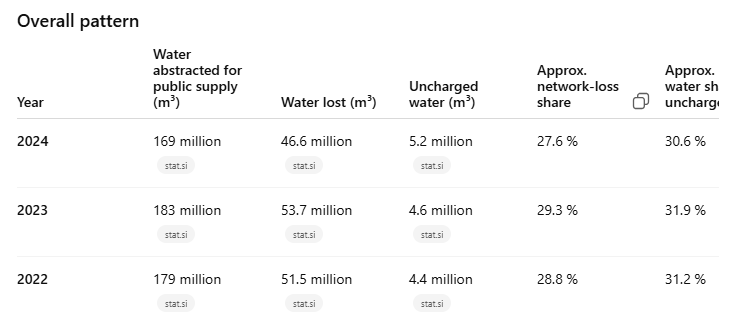
Research on water losses in Slovenia is alarming
A 2025 study by Dr. Daniel Kozelj (University of Ljubljana) reveals sobering data:
- Average losses: Slovenia loses an average of approximately 29% of the water it pumps.
- Range: Larger municipal companies are at ≈25%, while smaller and technologically outdated systems reach as much as 45% losses.
- Trend: Despite improved billing, the absolute volume of unbilled water increased by 11% between 2014 and 2023.
- Critical point: The national infrastructure leakage index (ILI) is 3.6, which indicates a weak
- Average losses: Slovenia loses an average of approximately 29% of the water it pumps.
- Range: Larger municipal companies are at ≈25%, while smaller and technologically outdated systems reach as much as 45% losses.
- Trend: Despite improved billing, the absolute volume of unbilled water increased by 11% between 2014 and 2023.
- Critical point: The national infrastructure leakage index (ILI) is 3.6, indicating poor leakage detection and inadequate pressure management. [13]
The situation in Croatia remains critical
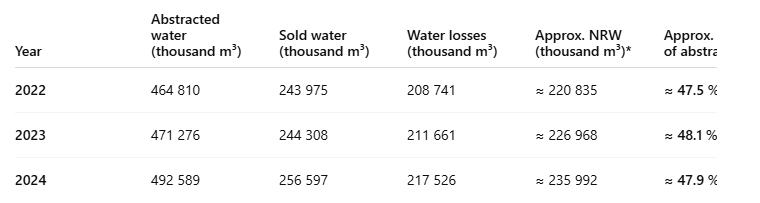
In Croatia, the figures are even higher and indicate stagnation in addressing technical losses:
- Losses in 2024: Public water supply systems lost more than 217 million m³ of water, which is 2.8% more than the previous year.
- Percentage of losses: This corresponds to approximately 44% of all water abstracted.
- Non-revenue water (NRW): The difference between water abstracted and water sold ranges between 47% and 48%. Almost half of the water abstracted generates no revenue. [14]
Examples of Good Practice from Abroad
- Example Ireland: With a targeted loss reduction program, they have managed to reduce NRW from 46% (2018) to 38% (2023). Their goal is to reach ≤ 25% by 2030. [5]
- England and Wales: The regulator Ofwat sets ambitious targets, such as an additional 17% reduction between 2025 and 2030. It monitors implementation and allows for innovation (e.g., smart metering). [6]
What does the practice of smart metering (AMI/SM) show?
Independent studies and regulatory analyses confirm that the investment pays off:
- Reduction in consumption: Households report a ~10–20% reduction in consumption. This is a combination of faster leak detection and changes in user behavior.
- Speed: AMI systems enable significantly faster detection of extraordinary events and anomalies. [7]
When Locking Hits the Wallet: Bad Practices Worth Avoiding
Two stories that serve as a warning: The initial convenience of turnkey solutions almost always comes back to haunt you in the long run. These anonymized examples show not only technical problems, but above all the unpredictable costs and delays that arise when you find yourself in vendor lock-in.
A. "Being tied to one ecosystem cost us two upgrades."
What happened?
For five years, the company systematically built a measurement park (a set of installed meters and field devices) on a platform that was architecturally adapted exclusively to the hardware of one manufacturer. The solution was initially free, functional, and transparent, but it did not enable true hardware agnosticism or support for standard interfaces from other manufacturers.
When the need arose to upgrade the system and include additional (new) meters, they found that the platform did not support any other devices without significant major interventions.
There were only two options available:
- Replacing the entire platform with a new, more open solution
- Replacing existing meters and continuing with the same hardware manufacturer
Both options meant high unplanned costs, project delays, and a new POC instead of a gradual upgrade.
The result of the above problem?
A 6–9 month delay and unplanned costs (licenses, integrator, testing). The OECD describes this pattern as a typical consequence of insufficiently flexible tenders. [4]
B. “Nice analytics, but locked data.”
What happened?
The platform offered excellent pressure profiling, but importing external sources was not supported.
The result of the above problem?
Without open APIs and standard formats, the economic impact of analytics does not spill over to the entire network. Regulation (Data Act) now requires switching and portability, but only if you require it in contracts and POCs.
Hw-Agnostic Approach in Practice and Where the Difference is Seen
Open standards and multi-vendor support are the only way to reduce TCO.
1, Open standards and multi-vendor.
OMS/(w)M-Bus (EN 13757-4) are established European standards for connecting meters and concentrators. Requiring OMS/(w)M-Bus in tenders and proven mixed fleets (POC) is the most practical step to maintain choice and reduce TCO. [8]
2. Communication flexibility.
Today, (w)M-Bus/OMS coexists with NB-IoT/LTE-M in practice, and increasingly with mioty (OMS TR-08). If the platform is not "tied" to a single RF stack, you can gradually introduce new communications without costly "rip-and-replace" projects. [9]
Where does eMR Fusion 2 fit in?
eMR Fusion 2 is designed as an HW-agnostic approach and is independent. It supports different meter manufacturers and multiple communication layers (LoRaWAN, NB-IoT, MQTT, AMR/(w)M-Bus), has connectors to GIS/billing/ERP, and clear export formats. In practice, this means:
- Less lock-in: you can combine equipment from different manufacturers and thus optimize your purchases on the market at all times.
- Faster and cheaper upgrades: switching to new technologies (such as the new LPWAN) or adding measurement types is just an integration project, not an expensive replacement of the entire infrastructure.
- More efficient use of data: the same data stream feeds billing, GIS, operational dashboards, and PZI documentation—without duplicate entries and extra work.
- A wider range of data in a single system: in addition to traditional meters, the same platform can also handle data from smart hydrants, such as pressure measurements, hydrant status (open/closed), and noise detection sensors. This enables early detection of leaks and a more preventive approach to network management, rather than responding only to sudden losses or increased water bills.
Proof in numbers from our references: eMR Fusion 2 has been on the market since 1997. The platform is used by 80+ users in 7 countries and records more than a million readings per year. It has been proven to be independent of meters and communication protocols. (Source: internal eMR brochure, 2025)
Comparison Table for Quick and Easy Decision Making
|
Aspect |
HW-agnostic approach (e.g., eMR Fusion 2) |
Platform tied to a single manufacturer |
|---|---|---|
|
TCO 5 years |
Lower after 2–3 years (competitive procurement, no rip-and-replace). |
Affordable at the beginning, but expensive upgrades (adapters, migrations, license uplifts). |
|
Integrations |
Pre-built APIs/connectors (GIS/ERP/billing/SCADA). |
Often limited to proprietary ecosystem; other integrations are "project". |
|
Standards |
OMS/(w)M-Bus, support for multiple RF/LPWAN (NB-IoT/LTE-M, mioty). |
Primarily optimized for own RF/protocol. [8] |
|
Data portability |
Documented export formats; "exit" clauses are meaningful and enforceable (Data Act). |
Often complex or expensive to export; high risk of vendor lock-in. [1] |
|
Security (NIS2) |
Applications, traceability, incident reporting — easier to prove with open architecture. |
Depends on the supplier; high dependence on a single actor. [10] |
How Much Does It Cost? (TCO Calculation Example)
Scenario (illustrative/fictional. This is just to give you an idea of the scale. You can replace it with your own figures):
- Size: 50,000 meters
- Change in 5 years: Replace/expand 20% of the fleet (10,000 meters) with another manufacturer
- Upgrade: additional new LPWAN
- Integrations: you need ERP + GIS + billing integration.
The estimated hidden costs are then:
- Data migration/adapters: 10,000 meters × €6/unit for conversion and validation = €60,000 (one-time).
- Additional communication layer: new RF infrastructure + integration = between €120,000 and €180,000 (depending on topology and SLA).
- Integrations (ERP, GIS, billing): between €30,000 and €50,000 costs of connecting to key systems (pre-built connectors are cheaper).
- Total risk: between €210,000 and €290,000, possibly more
Key lesson: Where is the difference?
With a tied platform, the above cost scenario often shifts upwards due to license uplifts and a closed data model.
With HW-agnostic architecture, however, costs generally remain below the threshold because there is no replacement of the entire stack and because there is more procurement competition.
Remember: The OECD warns that it is the tender conditions that determine whether subsequent migration will be financially "devastating" or manageable. [4]
Checklist Practice > Promises (How to Really Secure Your Project)
Don't just believe the promises. Use this checklist to prepare tenders and implement POC (Proof of Concept) to avoid lock-in and risks:
- Standards: require OMS/(w)M-Bus (EN 13757-4) and proven interoperability (not just "compatible"). [8]
- Portability (Data Act-ready): contractually specify periodic export (CSV/JSON + schema), migration deadline (e.g., 60 days), and cost schedule. [10]
- Live testing (POC): test 2 manufacturers + 2 communications (e.g., wM-Bus + NB-IoT/LTE-M) in advance with real data in the same analytics platform.
- Cyber Security (NIS2 necessity): request evidence of role management, traceability, incident reporting, and supply chain transparency. Remember: responsibility lies with management.
- SLA & roadmap: published update cycles (roadmap), guaranteed response times (SLA), and a clear de-provisioning process for exit.
Where is this digitization actually noticeable?
Reduced household consumption:
Smart metering and monitoring leads to a ~10–20% reduction in consumption on the bill due to behavioral changes and faster detection of anomalies. [6]
NRW and leak detection:
AMI (Advanced Metering Infrastructure) in conjunction with proactive customer notification and pressure profile analysis significantly reduce non-revenue water (NRW). Numerous studies and projects show sustained annual savings after the introduction of leak notifications and improved detection. [12]
What Do You Gain From Our Solution?
Are you looking for a solution that fits your case without the risk of lock-in? As an independent platform and integration provider, we help you choose the optimal set of HW, communications, and platforms.
Our team covers the key phases of the project:
- Comprehensive consulting and due diligence: lock-in risk analysis, TCO assessment, interoperability plan.
- PZI (implementation project): plumbing/construction work in connection with information architecture, communications, and power supply.
- System integration (GIS/ERP/billing/SCADA), cyber security (NIS2), SLA.
- Hardware & RF testbedding: comparative testing of meters/communications in your network.
- Operational implementation of eMR Fusion 2 as an HW-agnostic layer: same data for operations, GIS, and billing; no duplicate entries; no ties to a single manufacturer.
The end result: lower TCO over 3 to 5 years, fewer operational risks, faster response times (fewer calls, fewer breakdowns), measurable savings in water and energy. (We take your NRW and regulator targets as the baseline; together we set KPIs and a timeline.)
If you want digitization to boost efficiency (and not just replace paper with screens), the following are key: open standards, data portability, POCs with multiple manufacturers and a clear exit in the contract. This allows you to remain in control of the decision—and your money.
VIRI:
- https://digital-strategy.ec.europa.eu/en/factpages/data-act-explained
- https://iwaponline.com/wpt/article/doi/10.2166/wpt.2025.113/109252/Water-loss-management-in-Europe-perceptions
- https://www.eea.europa.eu/en/analysis/indicators/use-of-freshwater-resources-in-europe-1
- https://www.oecd.org/content/dam/oecd/en/publications/reports/2023/06/managing-risks-in-the-public-procurement-of-goods-services-and-infrastructure_b0d29f96/45667d2f-en.pdf
- https://www.water.ie/sites/default/files/projects/strategic-plans/national-water-resources/1.-Framework-Plan-NTS_-WIP-For-Final-Adoption-V6_2021_05_24.pdf
- https://www.ofwat.gov.uk/households/supply-and-standards/leakage/
- https://www.ofwat.gov.uk/wp-content/uploads/2024/09/Ofwat-Smart-Metering-Report.pdf
- https://oms-group.org/wp-content/uploads/2024/05/OMS-Spec_Vol1_General_v241.pdf
- https://oms-group.org/wp-content/uploads/2024/05/OMS-TR08_mioty_v1.0.1-2.pdf
- https://digital-strategy.ec.europa.eu/en/policies/nis2-directive
- https://ec.europa.eu/newsroom/cipr/items/753540
- https://allianceforwaterefficiency.org/wp-content/uploads/2023/03/An-Evaluation-of-AMI-Enabled-Proactive-Leak-Notification-Programs.pdf
- https://is.ijs.si/wp-content/uploads/2025/09/ENV_2025_paper_4.pdf
- http://podaci.dzs.hr